News
In Abidjan, Julie Laurenge is presenting the exhibition “Bleu(s) Laurenge: Cradle of Humanity 2020–2026” at the Tetchi Gallery
She almost always appears dressed in blue or similar shades, coordinating the accessories that complement her outfits just as skillfully as she articulates her thoughts on her work. For Julie Laurenge, a French painter born in Lille in 1991 and holder of a Master’s degree in medieval art history, blue has never been, in fact, merely a matter of color: in her hands, it has become the story of an evolution, an energy, and, beyond that, an identity—both physical and spiritual—linking the Ivory Coast and Ghana, two countries to which the Ashanti cosmogony connects her. It is this connection that the exhibition “Bleu(s) Laurenge: Cradle of Humanity 2020–2026” celebrates, on view through September 22 at the Galerie Tetchi in Abidjan.
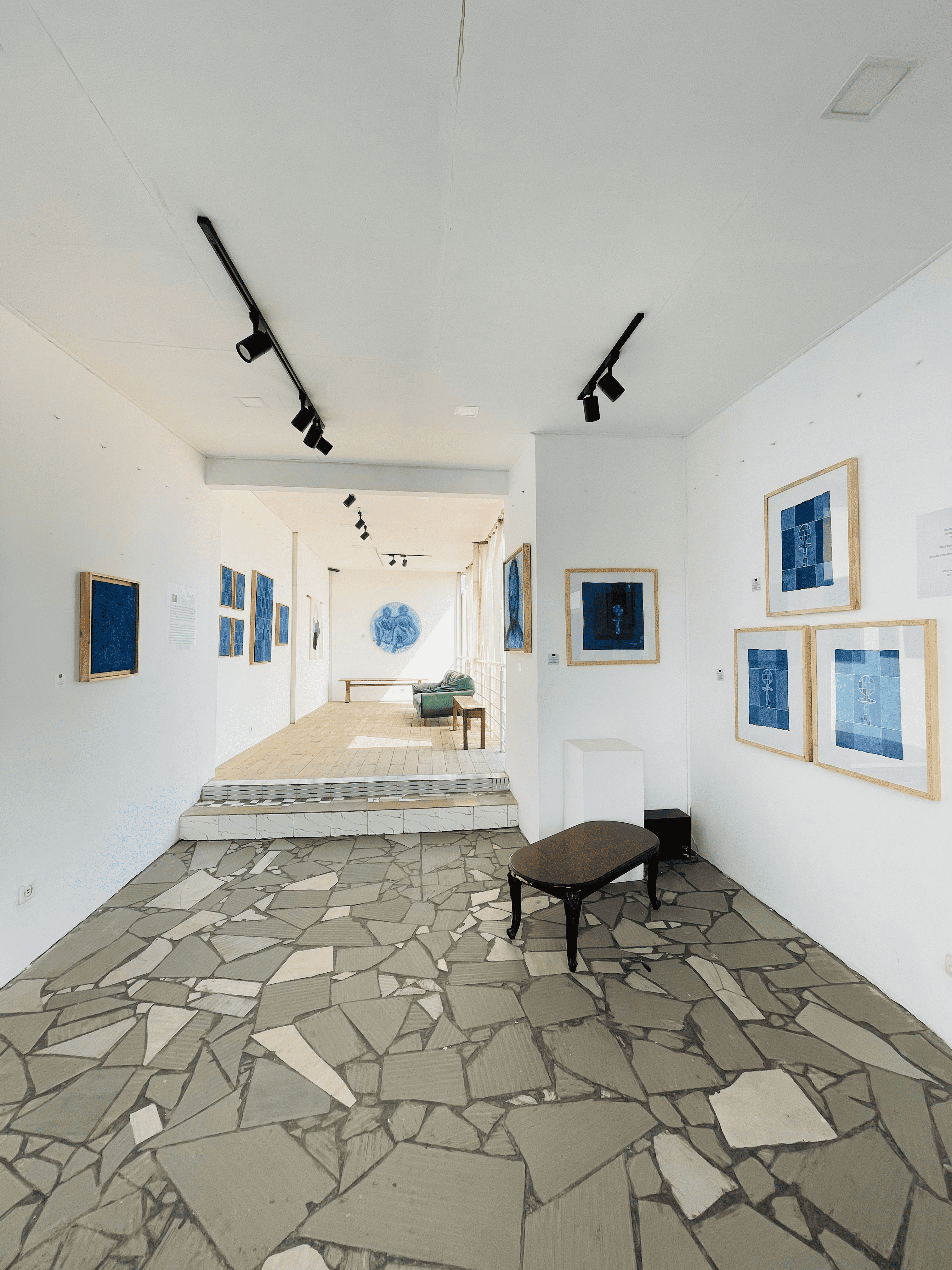
Creating from a single color, ancient masks, woven loincloths, and above all, the intimate… This is what Julie Laurenge offers in her first solo exhibition, which has been on view since August 6 at the Galerie Tetchi in Abidjan, Ivory Coast.
In this exhibition, blue is everywhere—and that’s no coincidence. The artist asserts that it is a conscious choice—almost a discipline—reflecting an energy she says she recognized within herself before recognizing it in the color itself; it is the energy of a personal style of dress that becomes an extension of her work and, above all, the depth she seeks to achieve in every painting. Thus, for her, blue functions as an inner, peaceful tone—a thread of stories to share with the world.
A practice centered on blue, spanning the kplé kplé goli, the Matières Précieuses, and the Ashanti doll
In 2019–2020, the world was locked down by the COVID-19 pandemic. During this moment of silence—which felt almost eternal—the French painter discovered the kplé kplé goli mask. It is the first face of the goli, a dance performed by the Baoulé to honor their ancestors and invoke their protection. In tradition, the kplé kplé goli is the one who precedes, the one who awakens. “It clears the path. It heralds what is to come. It prepares the spirits for the arrival of the more imposing masks,” explains the exhibition text written by Malcom Garnier. And as if by chance, alone in her room, it is this very mask that also clears the way for her—the way to the desire to recreate this painting in shades of blue.
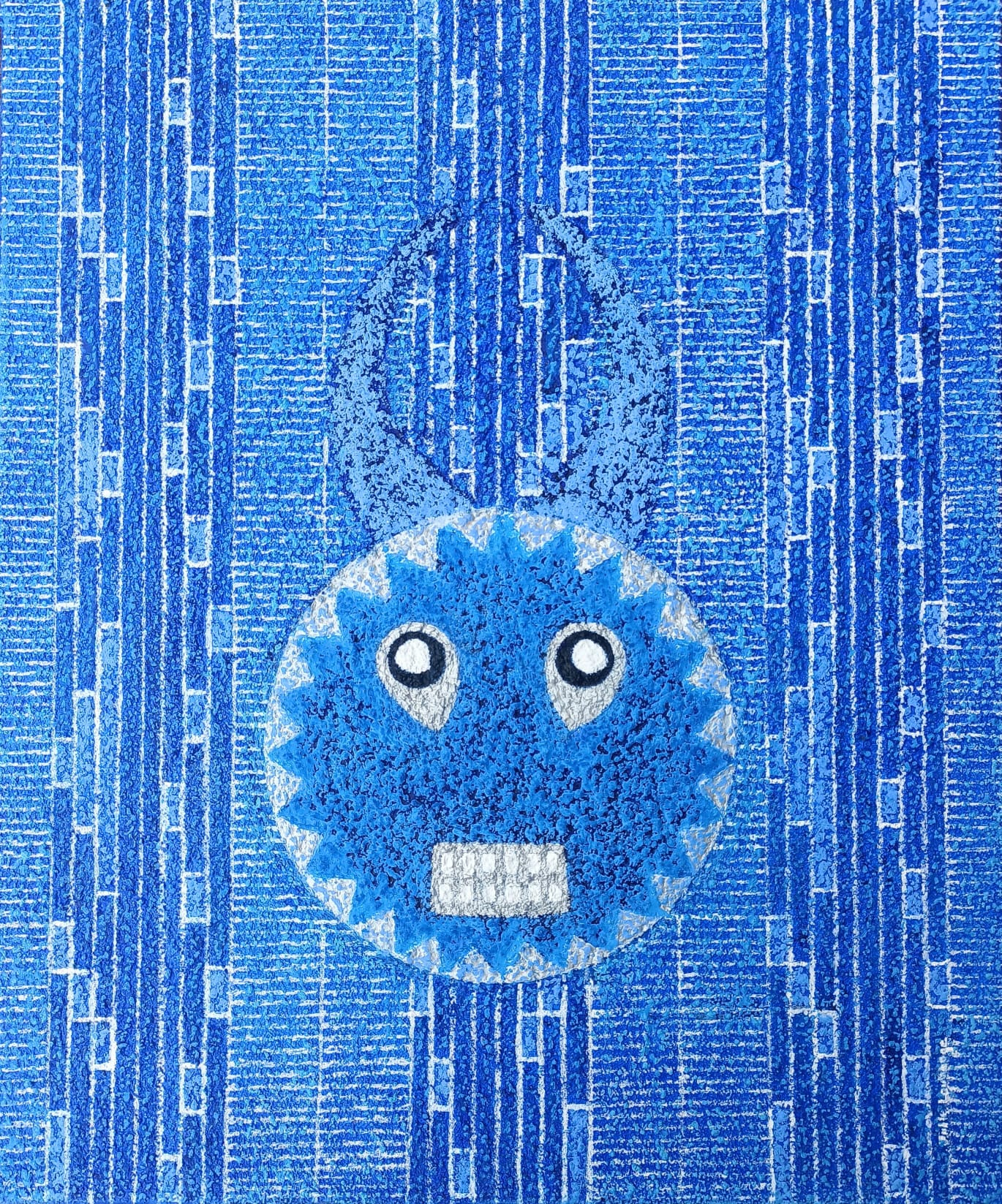
Julie Laurenge, “Blue Kplé Kplé Mask on Baoulé Loincloth, 2026. Mixed media on linen canvas, 63 x 54 cm. Courtesy of the artist and Galerie Tetchi
For Julie Laurenge, blue is not a color—it is a space. It is “the depth of the sky, the depth of water—the only two places where the human eye can never see the bottom.” The shade she uses echoes the indigo of the kita loincloth, a dye that has long been a symbol of wealth and refinement throughout West African societies.
The exhibition’s itinerary also features the Baoulé loincloth, as well as various series of paintings whose titles speak for themselves: “Les Transcendances,” “Amour Spirituel,” and “Mondes.” At the heart of this project are also the Ashanti “akua’ba” dolls. These figures with disc-shaped heads, once worn by women seeking motherhood, embodied an ideal of beauty and a gesture of care. By incorporating them into her paintings, Julie Laurenge recalls the function of the traditional art object and extends it into that of an object of transmission, one that traverses time and passes through successive hands to continue carrying meaning.
The artist’s blue, as it settles upon these figures, lends them a particular, more intimate, and deeper clarity—one that diverges from the usual gaze. In this approach, one senses the ambition to create a dialogue between a contemporary hue and inherited objects—a search for the infinite rather than the finite: thus, blue—with its nocturnal and unfathomable qualities—becomes the very substance of this bridge between continents and eras that the artist says she seeks to build.
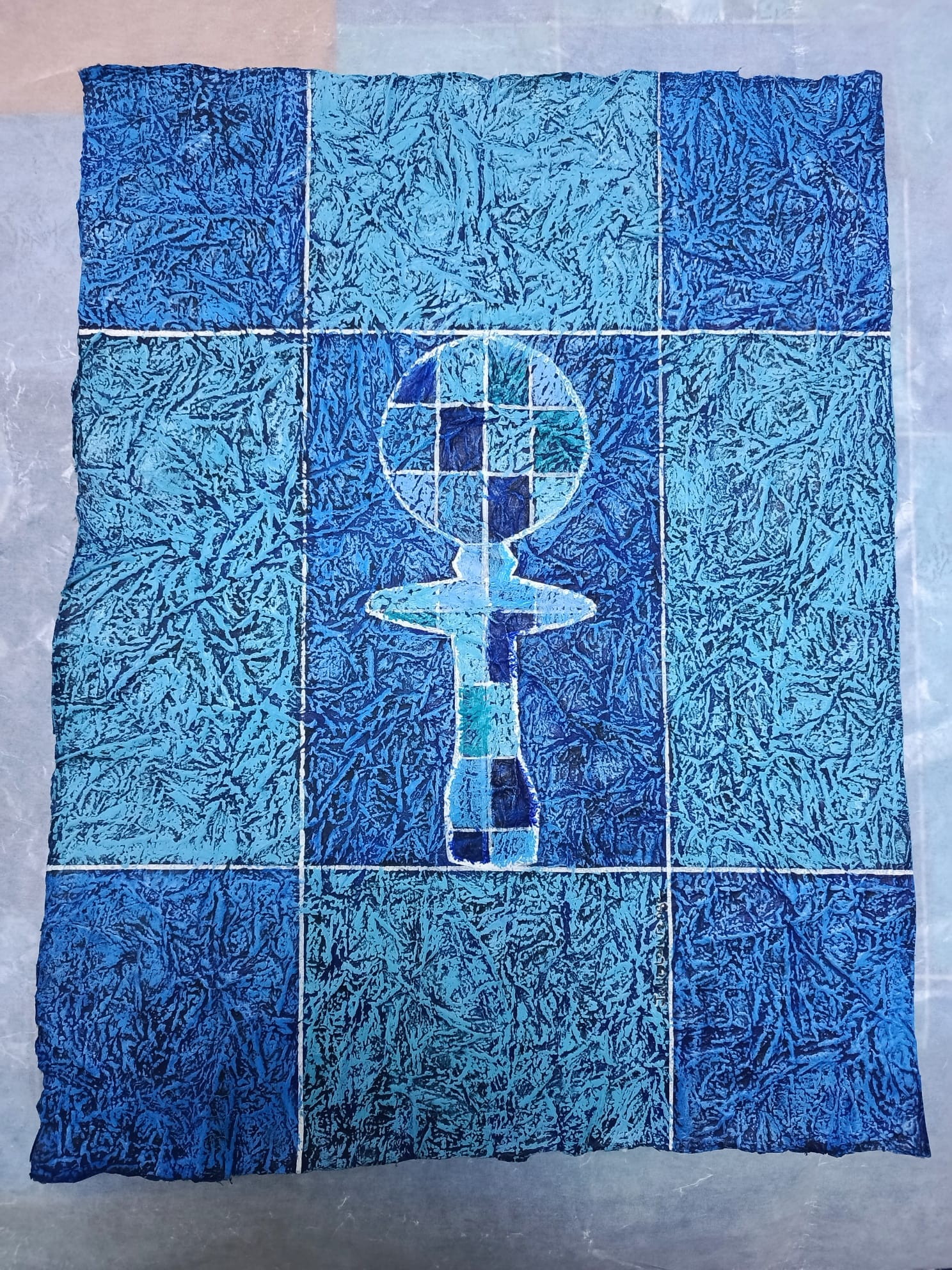
Julie Laurenge, “Small Ashanti Fertility Doll No. 1, 2026. Acrylic with pigments and oil pastels on handmade cotton paper, 74 x 64 cm. Courtesy of the artist and Galerie Tetchi
Just like the spiritual connection she has forged with the Ivorian painter Zopapi
One of the highlights of the exhibition is the collaboration between Julie Laurenge and Zopapi, a painter from the emerging Ivorian art scene. More than just a dialogue of techniques, this encounter is a spiritual partnership.
Although Julie Laurenge had considered several collaborations, it was with Zopapi that the artistic chemistry quickly took hold, giving rise to the “Mondes” series. A natural partnership: both artists operate within the same sphere of artistic inquiry, where the Akan people are at the heart of their practices—the Komians in Zopapi’s work; the woven kita cloth and the kplé kplé goli mask in Laurenge’s.
Born in 1998, Zopapi is a rising star on the Ivorian art scene whose almost choreographic creative process involves repetitive splashes of paint on the canvas and the use of the modoua, a ritual whip used by Komian priestesses. Known for his vivid chromatic style, he focused primarily on his signature blues in this collaboration to develop, alongside Laurenge’s bluish universe, a vibrant visual language that reflects a fascinating dialogue between past and present.
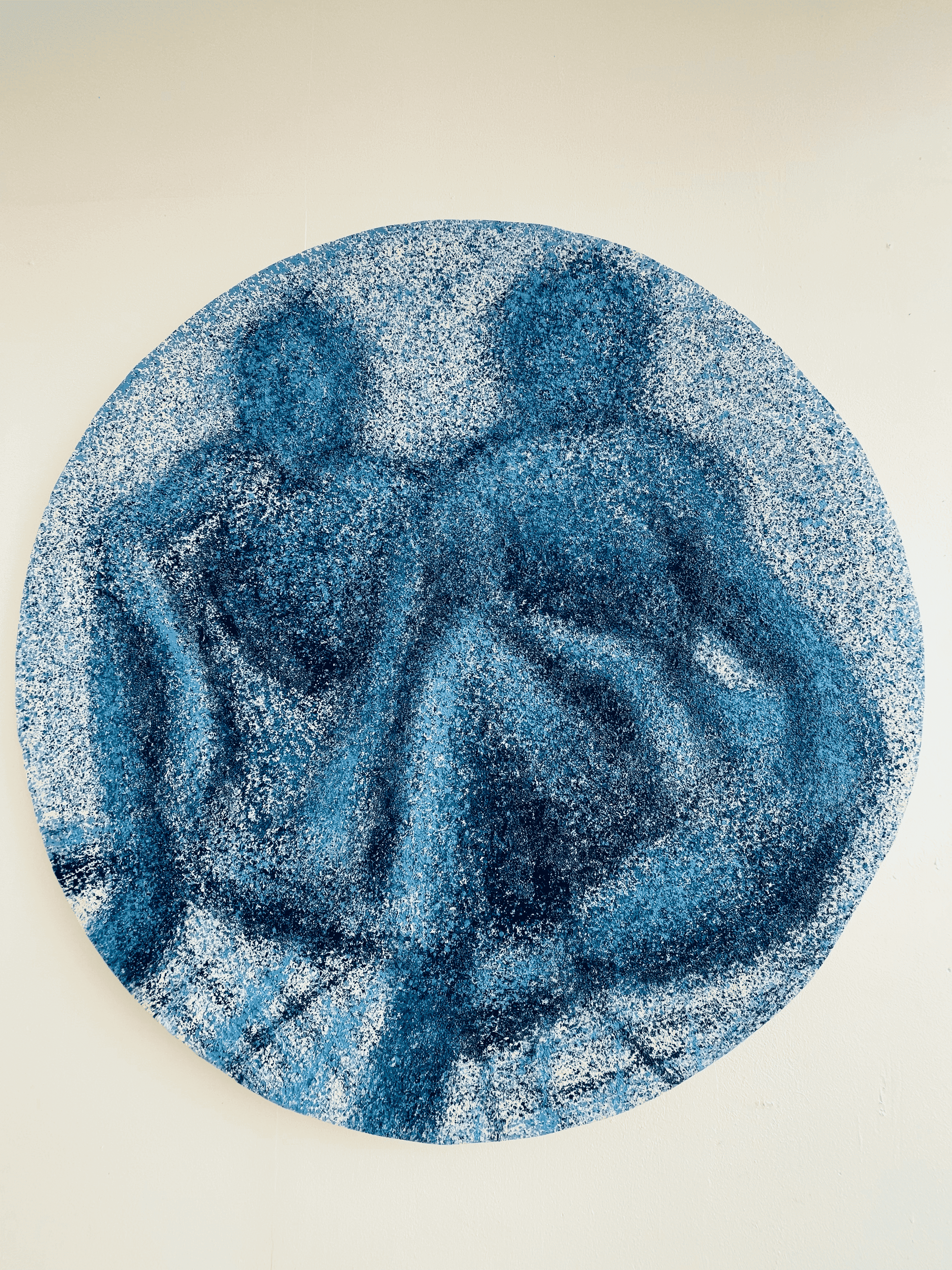
Julie Laurenge and Zopapi, “Identité d’Êloia ET Êba N’Ada, 2026.” Mixed media on cotton canvas, 120.5 cm in diameter. Courtesy of the artists and Galerie Tetchi
A retrospective focused primarily on the works of Julie Laurenge
It is important to clarify this to properly contextualize the exhibition: “Bleu(s) Laurenge” is primarily conceived as a retrospective of the artist’s second series, “Traits of Humanity,” which began in early 2020—with “Cradle of Humanity” as its first installment—and serves as a tribute to the African continent. The thirty or so works on display, created on various media such as handmade cotton paper, canvas, and woven pagne, date mostly from the year 2026, giving the exhibition the feel of both a retrospective and a new beginning.
Visitors leave “Bleu(s) Laurenge” with a sense of calm, silence, and a blue that does not seek to dominate but rather to soothe the audience. This exhibition is a must-see, above all for the artist’s ability to bring together—within a single color—personal energy, the Akan textile heritage, and Ashanti cosmogony, without ever allowing one to overshadow the others and far removed from ethnocentric perspectives on African cultures.
Exhibition “Bleu(s) Laurenge”
At the Tetchi Gallery, in Abidjan, Ivory Coast
Through September 22, 2026
More info: https://www.instagram.com/galerietetchi/
Commentaires