
Zoom
“Torn Silk, Living Memory!”
The ASCA Iba Ndiaye Dadji Prize for Art Criticism was awarded, on May 31, to Hawa Haby Thiam of Senegal, for her review of the work “Au Fil(s) de Soi(e)” by the Martinican artist Agnès Brézéphin. In this article, we publish the full text of the winning essay, which received a prize of 500,000 FCFA from the Senegalese Association of Art Critics. As a reminder, the ASCA Iba Ndiaye Dadji Art Criticism Award aims to recognize the best articles on artistic works related to the Dakar Biennale of Contemporary African Art. The call for submissions for this award considered publications released between November 7 and December 15, 2024, and was open to individuals of all nationalities aged 35 or younger as of December 31, 2024. The other two winners are Méghane Mathieu from France—whose essay we had previously published—and Moussa Seck from Senegal.
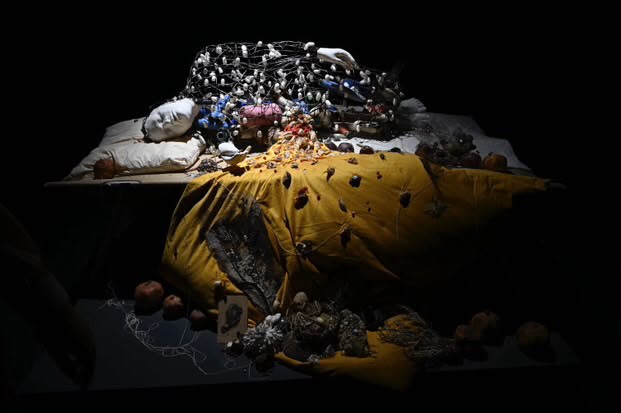
The title “Fil(s) de Soi(e)” plays on the double meaning of “soi” (personal identity) and “soie” (silk), a delicate material symbolizing the vulnerability and complexity of the human experience in the face of trauma. The thread, a symbol of both connection and rupture, evokes the fragility of human bonds and deep wounds, particularly incest, which shatters one’s identity. The plural form of “fils” suggests several dimensions: family ties, the scars left by trauma, and the traces of one’s lineage. The title explores the possibility of healing these fractures of the soul, while emphasizing that the marks of the past remain visible. It thus echoes resilience and the quest for reconciliation between the personal and the collective. The work invites a poetic reflection on suffering, healing, and memory.
At first glance, the body lying on a bed, overflowing with threads, strikes the viewer with its visual power. These threads seem to symbolize the gradual ebb of life, essence, and innocence, leaving behind a fragmented husk in which only the sensory organs are sculpted. This choice highlights the persistence of sensory memory: even if the body is emptied, the senses remain irrefutable witnesses to the violence endured. This contrast between a residual life—represented by these still-active senses—and a spectral presence conveys the devastating impact of incest.
The body depicted in this way oscillates between a residual life (the still-active sensory organs) and a ghostly presence (the rest of the emptied body). This contrast reinforces the idea that the trauma of incest is not merely physical violence, but an act that destroys the whole being, while trapping the victim in a state of survival. This is not merely physical violence, but an act that destroys the whole being. The symbolism of the materials used further enriches the work’s significance. Textiles and sewing, often associated with femininity and the domestic sphere, are here repurposed to convey a universal message. The softness of silk contrasts with the brutality of the subject matter, highlighting the duality between fragility and violence. Embroidery, for its part, becomes a powerful metaphor: that of a meticulous act of healing, steeped in emotion. In many cultures, embroidery embodies care and resilience; here, it evokes the possibility of mending the physical and emotional wounds left by incest.
By incorporating a quilt from her childhood, Brézéphin infuses her work with an autobiographical, personal, and intimate dimension, showing how trauma takes root in everyday objects. But she goes beyond the private sphere to spark a collective reflection. By making her personal experience public, she gives a voice to victims who are often silenced and denounces the injustices done to them. Through this approach, she transforms personal pain into a universal issue, calling for collective awareness of a societal scourge that is largely ignored. The work’s delicate aesthetic, combined with its profound commitment, creates an emotional impact of rare intensity. Through its embroidery, her childhood quilt, and its symbolic significance, “Fil(s) de Soi(e)” speaks to both the heart and the mind. Brézéphin compels the viewer to confront the victims’ pain, while encouraging them to recognize this suffering as a collective issue.
The nest holding the skeletal remains of a baby evokes the rejection of the newborn despite the desire to nurture it. Yet this desire pales in comparison to the urge to separate from it, given the circumstances of its conception. The artist invites us to reflect on the duality of feelings aroused by procreation under atrocious conditions that run counter to our values.
The fruit of incest becomes more bitter than the taste of the egg yolk depicted next to the baby’s bones. The nest symbolizes a place of safety for a newborn. A place where the baby expects to be nurtured and loved. Yet in this work, the baby lies lifeless there—evidence of the indifference, rejection, and lack of love shown by its mother. The womb cries out its distress, but in its own way.
This work is not merely an artistic creation; it is a genuine political and therapeutic act. Agnès Brézéphin reinvents the artistic gesture by transforming it into a tool for poetic justice and collective healing. “Fil(s) de Soi(e)” powerfully demonstrates that art can not only heal, but also raise awareness and mobilize. Through this masterful work, Brézéphin situates her art within a committed approach, blending aesthetics and activism to bring to light a voice and a memory that have long been silenced.
This work stands out as one of the most striking creations of this 15th edition of the African Biennial of Contemporary Art. By combining striking aesthetics with deep commitment, it illustrates that art transcends mere visual contemplation to become a vehicle for a message and a tool for making an impact on the public. True to this year’s theme, “The Wake,” the work fosters collective awareness and invites an essential dialogue about the personal wounds and universal issues it raises.
Hawa Haby Thiam.
Commentaires