Le Grand Entretien
Agi: “Through this exhibition, I wanted to pay tribute to these Amazons, symbols of strength and resilience.”
At La Maison Rouge in Cotonou, painter Agi (born in Paris in 1971) is presenting, through November 29, “Les Merveilleuses,” an original exhibition celebrating Beninese and African women and their resilience through a series of graphic and colorful portraits that blend poetry, humor, lightheartedness, and elegance. Asakan.Art sat down with her to discuss her work and her perspective on these women—their smiles, their expressions, and their zest for life. Interview.
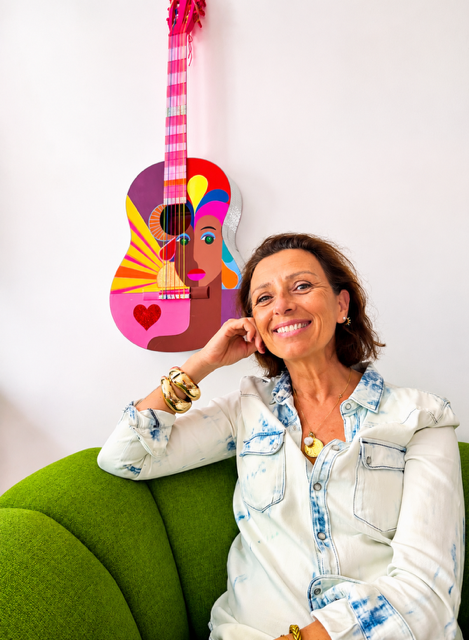
Asakan: Where does your stage name, Agi, come from?
Agi: My stage name comes from my initials: A for Alexandra and Gi for Gillet.
Asakan: From Algeria to Brazil, via Egypt, Réunion, Nigeria, and now Benin. What makes you move around so much?
Agi: I’ve been living abroad with my family for over 20 years in the countries you just mentioned. That’s why I’ve had to move around so much—mainly because of my husband’s job.
Asakan: You’re currently presenting the exhibition “Les Merveilleuses” at La Maison Rouge in Cotonou through November 29, 2026. What do you hope to evoke or inspire in the Beninese public?
Agi: I am very happy and deeply honored to have been able to present “Les Merveilleuses” to the Beninese public at La Maison Rouge gallery in Cotonou. At the opening, I met artists, people interested in art in general, and students with whom I had many conversations, and I really enjoyed talking with them.
A young artist came up to congratulate me on paying tribute to Black women. She pointed out that I had used brown to depict their skin rather than black, as is too often the case in her view: “We have brown skin, not black! It’s great that you painted it that way!” ” It’s interesting to evoke emotions in the audience, and that’s also the purpose of an artist’s work.
I admit I had no idea how the exhibition would be received. I had my doubts; I didn’t know how the audience would react. A white woman coming to Benin to exhibit paintings of Black women—one might question the legitimacy of that. And I saw the smiles, I saw faces light up, I received an outpouring of positive comments, joy, and kindness. That’s exactly what I wanted to evoke in the Beninese audience: a positive attitude, joy—what drives us all and what we desperately need right now. The pride in their eyes, because I paint them through my own eyes, my own vision. I couldn’t have dreamed of a better reception.
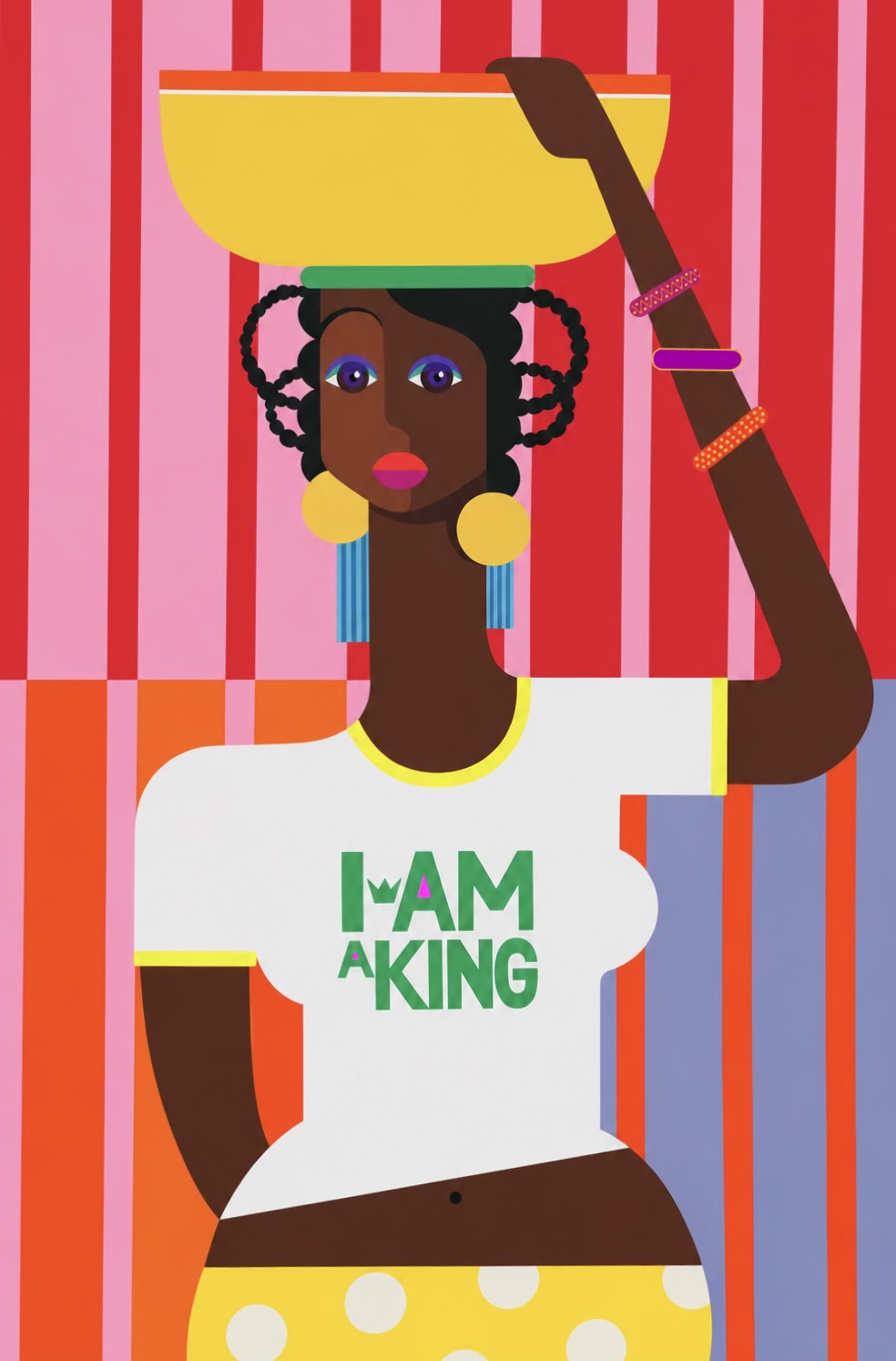
Agi, “Léonie,” 2025. Acrylic on canvas and collages, 122 x 183 cm. Courtesy of the artist
Asakan: From Algeria to Benin, you paint only portraits of women. Why this choice?
Agi: During my studies, I focused extensively on portraiture at the Academy of Fine Arts. Ever since I was very young, I’ve also been drawn to the shape of faces. It’s true that the subject of women emerged naturally, probably because I feel justified in doing so, being a woman myself. Living in culturally contrasting countries—Algeria and Brazil, for example—has left a deep impression on me. The role of women varies greatly from place to place, and I’m fascinated by their ambiguity—a masterful blend of strength and vulnerability.
As for Benin and Africa in particular, African women impress me. They are beautiful, but that’s not all. They shoulder heavy burdens, they assert their identity with elegance, they dress extravagantly, they are unafraid of either bold colors or the stares of others—they are proud and self-assured. They wear extraordinary jewelry and sport incredible hairstyles. Through this exhibition, I wanted to pay tribute to these Amazons, symbols of strength and resilience. To me, they are an inexhaustible source of inspiration and admiration.
Asakan: So you’re not interested in men?
Agi: I’m not saying I’m not interested in men. I’m just more drawn to women for various reasons, but I’m not ruling out the possibility of painting men someday (smiles).
Asakan: Would you say you’re primarily a feminist artist?
Agi: Being a feminist means supporting equal rights, opportunities, and freedoms between women and men, so I think we’re all a little bit feminist, aren’t we? We have to fight against sexist discrimination—it has to be a struggle. Women have to fight just to exist, and there’s still a long way to go.
Asakan: How would you describe your creative process?
Agi: It all starts with a good dose of observation. I immerse myself in my surroundings and paint whatever I see first and foremost: the street is my playground. It can also involve encounters with people. Observation is a lengthy process. Understanding social cues, capturing glances—it’s intense sociocultural work and a journey in itself.
Next, I use my pencils and my sketchbook. I can fill pages with faces and ideas. I take notes. I experiment with colors. Then I finalize a sketch before moving on to the canvas—which is usually what I use.
After a fairly precise pencil sketch, I move directly to color. I then work with flat areas of color, applying several layers of paint to achieve a smooth finish. I finish by adding collages, fabric, or touches of rhinestones and glitter. I love it when things sparkle. I even feel like I never go overboard enough! That’ll come…
But this whole process can take more or less time. People often ask me how long it takes me to paint a canvas. It varies and is hard to estimate. Some give me a hard time, while others come together more smoothly.
Asakan: What’s the connection between the bright colors, bold shapes, and these “birds” that appear in all your paintings?
Agi: All these colors, these shapes, and the birds I incorporate are part of my world. There’s an instinctive element to my painting, and I’ll admit I don’t plan things out in advance. I create my shapes in the moment, freehand. I rarely go back to adjust a shape or a color. They either match (or they don’t, for that matter)—it doesn’t matter. What’s important is that the colors and shapes burst forth. The birds come in afterward to bring poetry and hope, and to make the canvas a moment suspended in time.
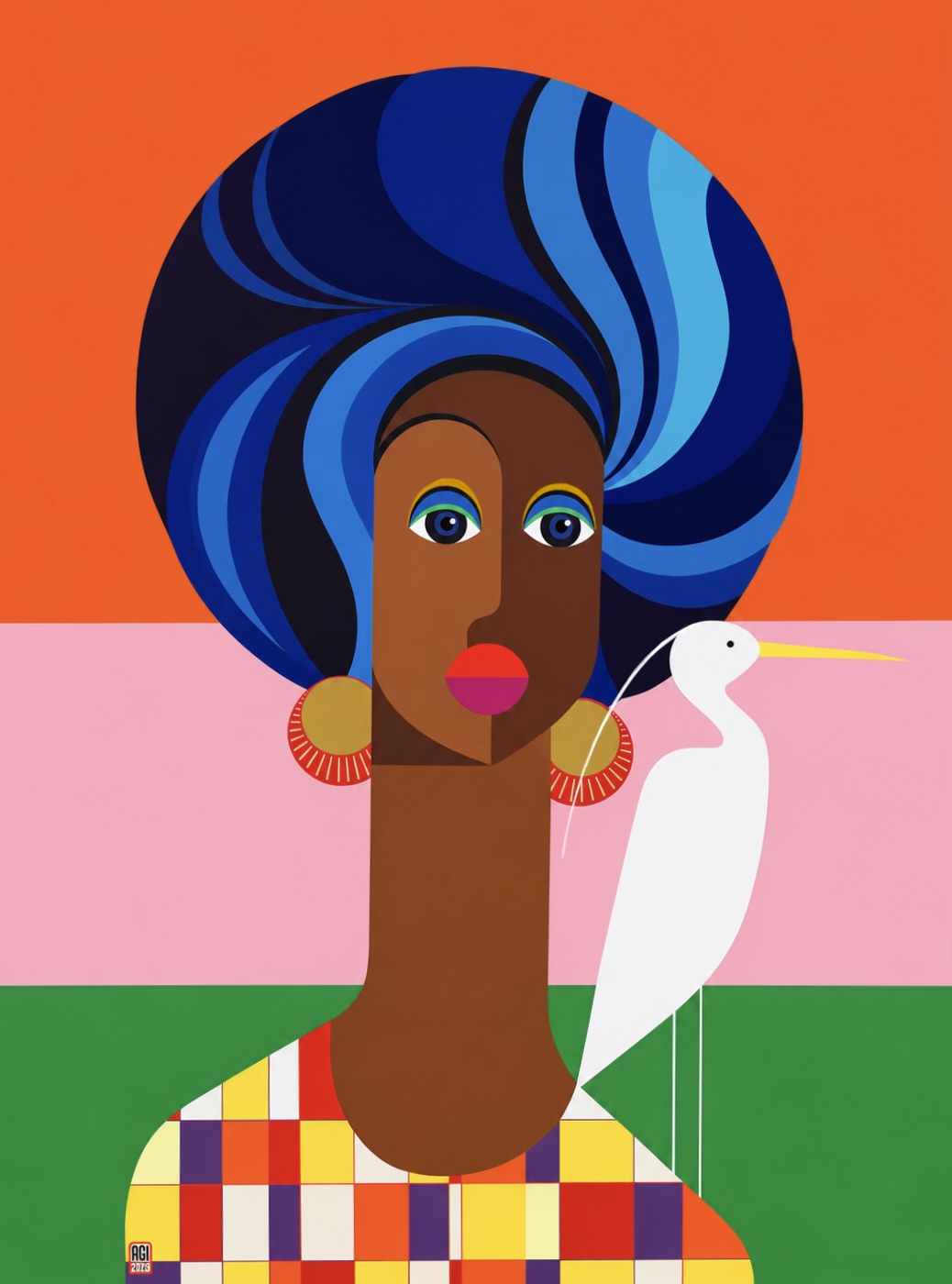
Agi, “Ayomide,” 2025. Acrylic on canvas and collages, 91 x 122 cm. Courtesy of the artist
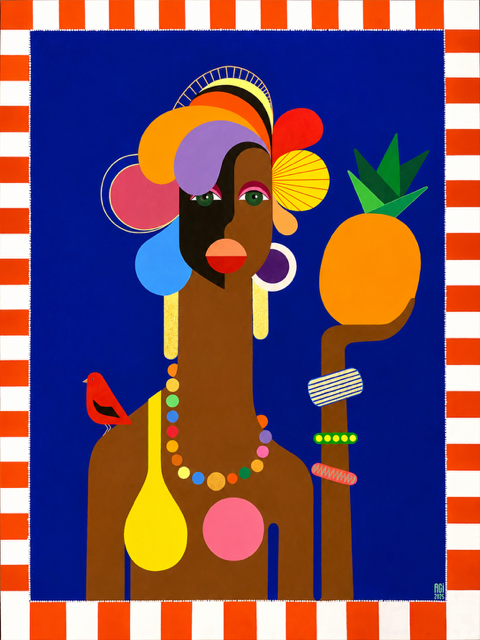
Agi, “Fifamè,” 2026. Acrylic on canvas and collages, 91 x 122 cm. Courtesy of the artist
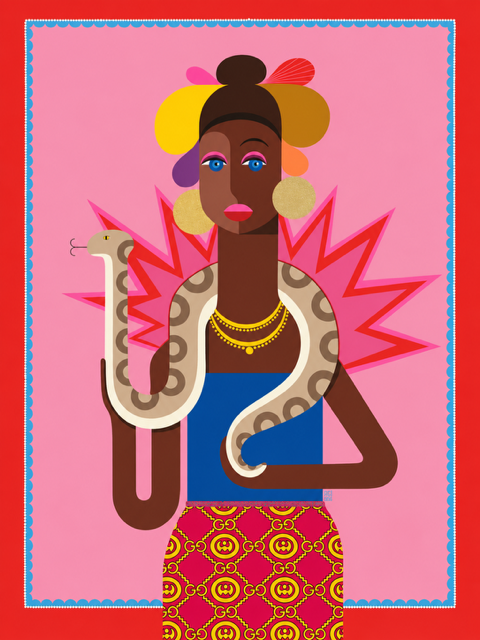
Agi, “Sèdami,” 2026. Acrylic on canvas and collages, 91 x 122 cm. Courtesy of the artist
Asakan: With that in mind, what do you want the public to take away from your work?
Agi: My work is a source of joy—and more than that. I’d like everyone to find a reason to smile in it.
I called my exhibition “Les Merveilleuses” because I also wanted to create objects. Each “Merveilleuse” is a messenger of hope and kindness. They are also woman-like creatures who quietly radiate their beauty and extravagance. To own a “Merveilleuse” is to possess a talisman, a modern “virgin” who looks at you and to whom you can confide.
Asakan: You’ve been living and working in Lagos for two years now. What’s your perspective on the Nigerian art scene?
Agi: The Nigerian and African art scenes, in general, are constantly evolving. They’re a bubbling cauldron of creativity, passion, and energy. Whether in painting, sculpture, or fashion, Nigerians are often incredibly active and talented artists. I’m always amazed by the people I meet at parties or art openings. Every time, it’s a real spectacle! It’s very inspiring.
Asakan: In your opinion, why is art so important in our lives?
Agi: Art isn’t just important in our lives—it’s essential. Whether it’s surrealist, socially conscious, or simply beautiful, I’m convinced that it brings people together. Because everything in our lives is “art”—not just painting or sculpture, but also cooking, traveling…
Art is the representation of the beautiful things that surround us: a flower or a bird, for example. It’s true that I tend to see art everywhere, and I wouldn’t want to change that.
Asakan: What advice would you like to share with other women and young people who want to follow in your footsteps?
Agi: Without wanting to resort to “cliché” advice, I’d say that, of course, you have to believe in yourself and your abilities. Everyone has an artist hidden inside them; you just have to listen to that voice and take the plunge. Follow your instincts (always), meet wonderful people, step outside your comfort zone, try not to let artificial intelligence swallow you up (too late?), and never think it’s already too late.
Asakan: Any final thoughts?
Agi: As I mentioned earlier, I was touched and honored by the warm welcome I received from the people of Benin. It’s encouraging and makes me want to keep going. I was moved because I felt like I’d shared some joy and received some in return—like a message of peace had been conveyed. Deep down, that’s also why I do this work.
Exhibition “Les Merveilleuses” by Alexandra Gillet, known as Agi, November 5–29, 2026, at Galerie Maison Rouge, Boulevard de la Marina, Cotonou, Benin. More info: @agiartiste or hotel-benin-maison-rouge-cotonou.com
À lire également
Raymond Tsham: “Belgians and Congolese, Africans and Europeans—we must overcome the divisions of history, unite, and foster genuine complementarity among our peoples.”
Featured in the exhibition “Living Legacies: Reinventing Forms” at the Galerie Person in Brussels alongside Mozambican artist Reinata Sadimba, Raymond…

Joseph Ntensibe: “… I try to capture the dramatic effect of tropical light on nature and translate that experience into painting.”
Today marks the final day of the group exhibition featuring the renowned Ugandan painter Joseph Ntensibe—who trained at the Makerere University School…

Rodrigue Glombard: “To me, these walls and floors are not merely fragments of urban architecture; they are repositories of the traces of time, human stories, and the transformations of the landscape.”
For some time now, we’ve been introducing you to the artists featured in the exhibition “Martinique, Intimate Cartographies,” on view at the Wall Hous…
Wilfried Mbida: “So I’m not talking here about natural disasters or destruction, although the topic could be broadened to include that interpretation.”
Through August 1, 2026, the PERSON Gallery - Brussels is presenting the exhibition “Living with Water: Spirituality and Resilience,” bringing together…
Commentaires